

News
Humanities Departments Are in Trouble, but ‘Applied Humanities’ Are in Demand, Harvard Panelists Say

News
Harvard Endowment Appoints 3 New Directors, Including JPMorgan Exec Who Managed Epstein’s Bank Accounts

News
On Survey of Harvard Undergrads, 63% of Respondents Favored Divestment from Israel

News
Summers Visited Epstein’s Island During 2005 Honeymoon

News
Summers Will Not Finish Semester of Teaching as Harvard Investigates Epstein Ties
When Harvard Cuts from the Bottom to Protect the Top
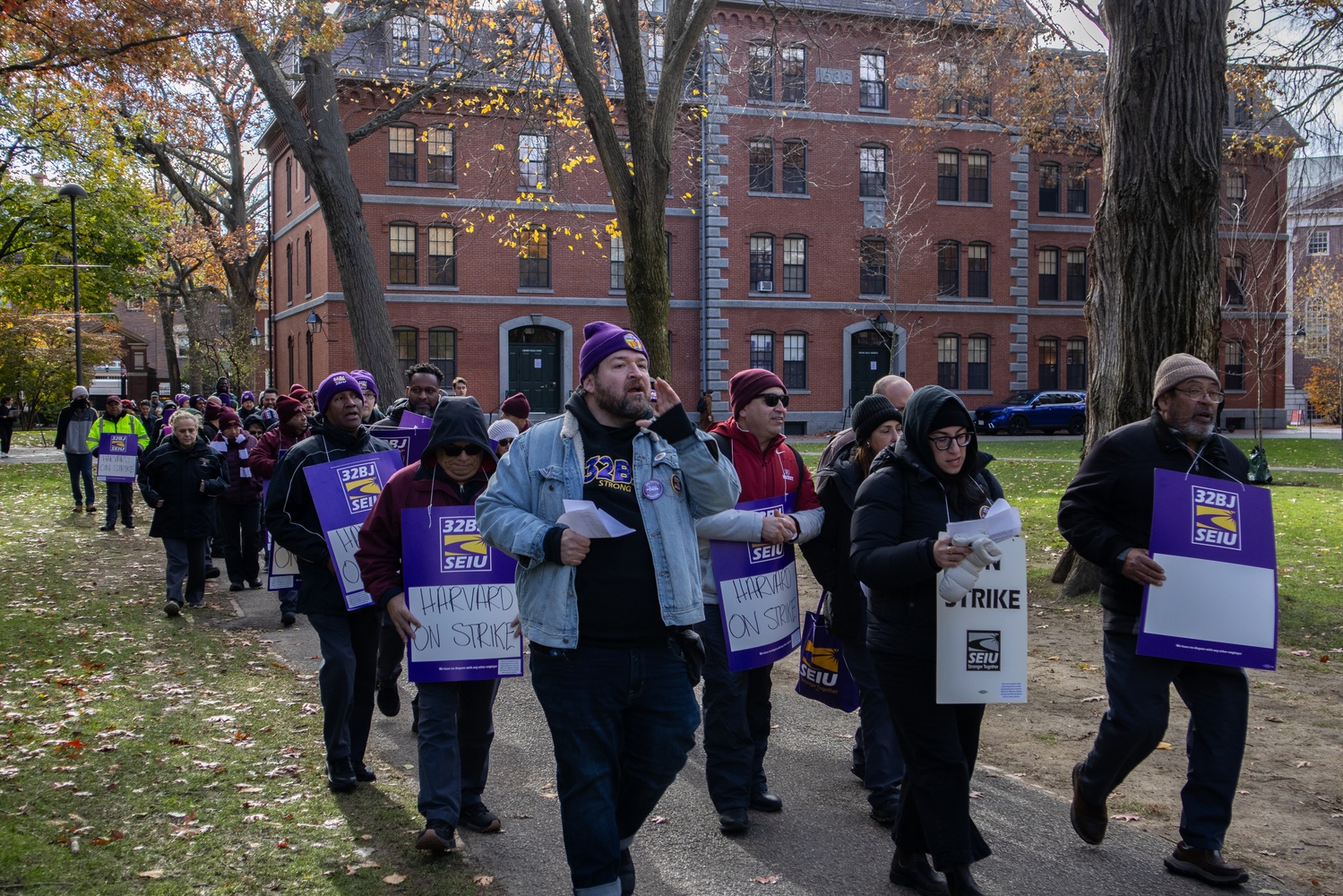
Harvard has a long history of devaluing the most vital and vulnerable.
In 1929, the state of Massachusetts ordered Harvard to pay its “scrubwomen,” female custodial workers, the minimum wage of 37 cents an hour. For eight years, Harvard ignored the law, informally colluding with state officials to keep at 35 cents. But when this “gentleman’s agreement” finally collapsed, rather than raising wages by 2 cents, Harvard fired all 20 scrubwomen and replaced them with men, whom they could legally pay a mere 32 cents.
Fast forward to mid-November: roughly 60 Harvard custodians flooded the Yard to strike after Harvard failed to provide union negotiators with a wage contract that kept pace with the current rate of inflation, among other demands. The image of a working class fighting for basic financial support from the richest university in the world bears an eerie resemblance to the scrubwomen scandal a century prior: Harvard is more than willing to sacrifice the most vulnerable members of its community, trading the livelihoods of its workforce for its own bottom line.
Harvard’s about 800 custodians are represented by the Service Employees International Union 32BJ. In October, the union began negotiations for a new contract. Their demands were reasonable: a wage increase that consistently keeps up with sustained inflation, stronger financial retirement options, and a contribution to a joint union-employer legal fund in light of the Trump administration’s campaign against immigration.
Despite over a month of negotiations, Harvard failed to produce a contract that came close to the union’s demands. Their proposed wage increases, an average of 2.25 percent over 4 years, with an only 1 percent increase the first year. If inflation continues to hover at 3 percent, which it has since 2023, Harvard’s proposal effectively lowers wages.
Some argue that the custodial workers already enjoy outsized privileges. They make $28 an hour, which is $13 above Massachusetts minimum wage. But is state law a rational way to measure workers’ needs in the current market? MIT’s living wage calculator estimates that the living wage in Massachusetts for a single adult working full-time with no children is $28.88. With a child, that number jumps to $55.15. With two children, it becomes $70.22. Even for two working adults with two children, the living wage exceeds the custodial wages by more than $19. It’s only fair that workers demand better benefits and wages that keep up with rising costs of essential goods like food and healthcare.
While custodial workers are not directly tied to Harvard’s mission of research and education, they are vitally important to Harvard’s functioning in the first place. These workers ensure that our restrooms are maintained, our trash is properly disposed, and supplies are constantly restocked. All domains of Harvard life are reliant on our custodial staff. Without them, education and research would be impossible.
Conveniently, the University is now using the demands of the same administration that slashed its funding as a justification to deprive the rights of its own workers. Harvard spokesperson Jason A. Newton cited “current financial challenges and ongoing uncertainty” — presumably from the endowment tax and Trump funding pressures — as a source of the University’s futile economic proposals. He also stated how these workers are “valued members of our community.” But if the University really believes in this claim, then why are our custodial staff the most expendable?
Harvard’s treatment of these workers as disposable begs a greater question: Which members of our community does Harvard value? And which ones is the University willing to sacrifice?
When Harvard fired the scrubwomen in 1929, bursar Arthur L. Endicott Class of 1894 claimed men would be more efficient, and, legally, could be paid less. The women – predominantly single, Irish Catholic, and supporting dependent children – could be easily replaced. Harvard’s current full time Services and Trades staff, encompassing custodial workers, is 34.6 percent Hispanic or Latino, and many are international workers. Again and again, when external forces threaten Harvard’s financial stability, it passes the force of the blow to its most vulnerable.
We’re closer than one might imagine to the massive income inequality in the time of the scrubwomen scandal. In 1928, the wealthiest one percent in the United States earned 24 percent of total income. In 2022, the wealthiest one percent earned 22 percent of total income. And now, with the reduction to Medicaid, the increasingly brutal immigration policy, and the massive cuts to food assistance programs like SNAP, the Trump administration actively widens this wealth gap. It’s inevitable that these policies will hit low-income workers the most.
Custodial workers should not be deadweight that Harvard casts aside amidst a tense financial situation. Instead, Harvard should advocate for these workers, engage in good-faith negotiations with them, and make clear that they are essential members to our University. Harvard claims it seeks to create a better world — it must start by supporting the workers that make that mission possible in the first place.
Dalevyon L.J. Knight ’27, an Associate Editorial editor, is a Chemistry concentrator in Adams House. Sylvia A. Langer ’28, a Crimson Editorial editor, is a Molecular and Cellular Biology concentrator in Currier House.
Want to keep up with breaking news? Subscribe to our email newsletter.