

News
Humanities Departments Are in Trouble, but ‘Applied Humanities’ Are in Demand, Harvard Panelists Say

News
Harvard Endowment Appoints 3 New Directors, Including JPMorgan Exec Who Managed Epstein’s Bank Accounts

News
On Survey of Harvard Undergrads, 63% of Respondents Favored Divestment from Israel

News
Summers Visited Epstein’s Island During 2005 Honeymoon

News
Summers Will Not Finish Semester of Teaching as Harvard Investigates Epstein Ties
Humanities Departments Are in Trouble, but ‘Applied Humanities’ Are in Demand, Harvard Panelists Say
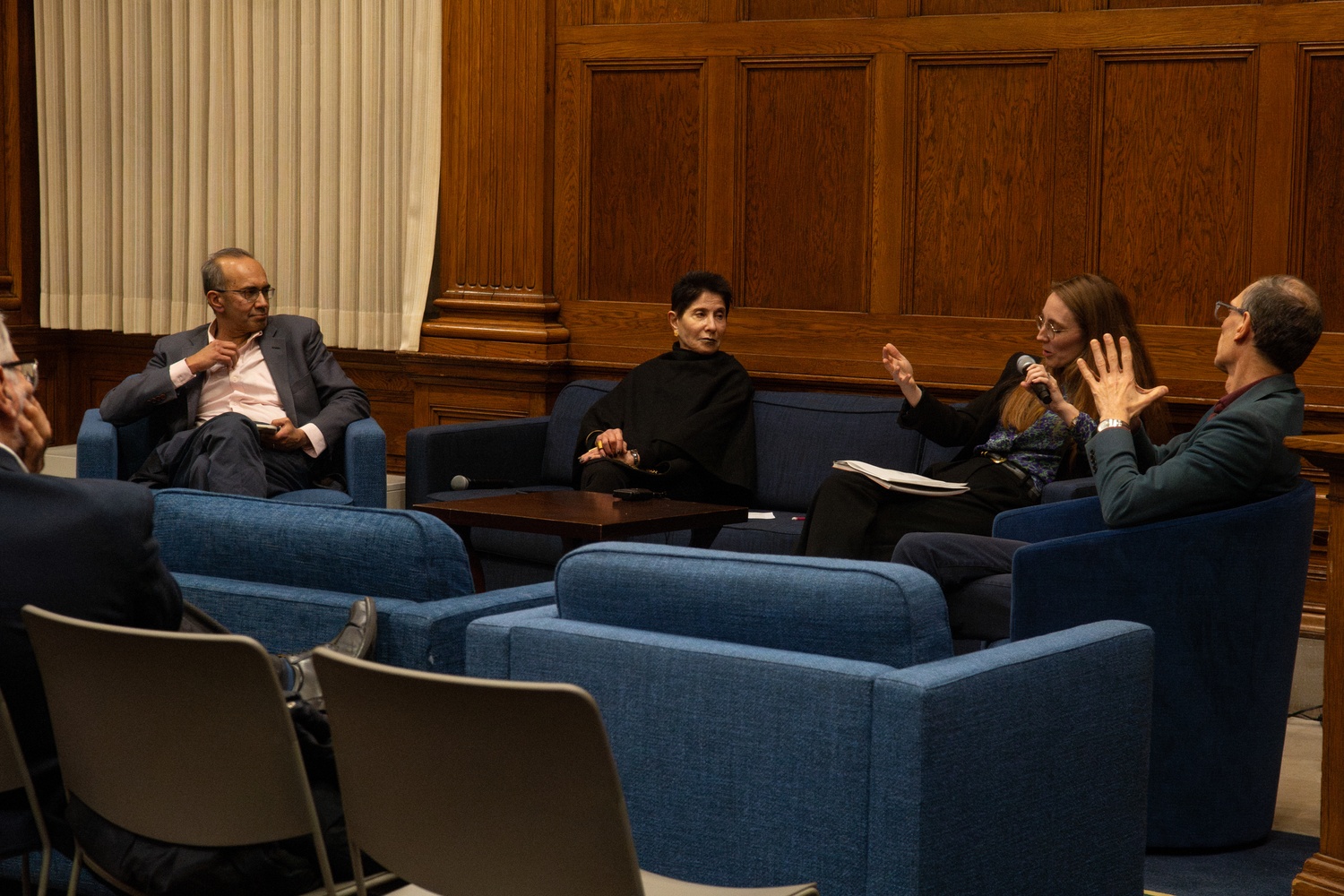
The humanities are struggling at universities nationwide — but outside the ivory tower, fields from Silicon Valley to politics need them more than ever, four Harvard professors said at a talk hosted by the English department last week.
The panel aimed to investigate what its moderator, English professor Martin Puchner, described as the “paradox” of rising demand for the humanities in the professional world — the “applied humanities” — even as the field faces headwinds within academia.
It featured Harvard Business School professor Tarun Khanna, Romance Languages professor Doris Sommer, and Comparative Literature professor Moira G. Weigel ’06-’07.
Weigel, who studies the history of communication technologies and wrote a book on workers in the Bay Area tech industry, said that she had observed a keen interest among entrepreneurs in thinkers from Friedrich Nietzsche to Marcus Aurelius.
“I think there’s a temptation, as a humanist, especially an insecure one working on a dissertation no one wants to hear about at parties, to be a bit snarky about this kind of thing — you know, when the daily Nietzsche shows up in your social life,” Weigel said. “But I think I want to take it seriously as sort of reflecting a sincere desire for cultivation.”
Theorists like Nietzsche and the Stoics, she speculated, might help tech leaders build their own senses of self — and deal with the uncertainties that even Silicon Valley titans can’t shake.
Even as generative artificial intelligence plows forward, disrupting humanities education and driving deep changes in the workforce, Weigel said humanists should do their best to engage in the development of what she described as “deeply textual technologies.”
“We have a lot to offer in thinking them through,” she said.
Khanna — who started Chai Point, an Indian tea company and cafe chain, with a student — said the business’s success relied on what amounted to an “anthropological investigation of people who have, for generations, brewed tea for a living.”
When the company’s initial efforts failed to attract customers, Khanna and his student decided to shadow tea makers whose families had spent “five, six generations” producing and serving tea. Their observations inspired them to program robots to replicate that ritual and tailor tea to each user based on biometric eye recognition.
“There’s something in ritualized experience that captures something very human,” he said. “It’s resulted in massive employment creation, much comfort for people, and economic value creation.”
Sommer said she thought of the humanities as important not just for their professional applications, but as a necessity for democratic politics. Increasing dependency on AI could allow human judgment, sociability, and critical thinking to “atrophy,” she warned.
But she said the humanities could help people keep their minds in shape.
“I want to leave you simply with a recommendation — if not a prescription, the way a coach would give you, or a doctor, a preventive medical prescription,” she told the audience. “And that is to do mental gymnastics.”
In the face of swiftly developing technologies, humanists have a duty to help educate people to become good thinkers and citizens, Sommer said.
“The ambition is to revive the foundational connection between democracy and the humanities,” she said. “And here, we have not only an opportunity, we have a responsibility.”
—Staff writer Ellen P. Cassidy can be reached at ellen.cassidy@thecrimson.com.
—Staff writer Catherine Jeon can be reached at catherine.jeon@thecrimson.com. Follow her on X at @cathj186.
Want to keep up with breaking news? Subscribe to our email newsletter.