

News
Humanities Departments Are in Trouble, but ‘Applied Humanities’ Are in Demand, Harvard Panelists Say

News
Harvard Endowment Appoints 3 New Directors, Including JPMorgan Exec Who Managed Epstein’s Bank Accounts

News
On Survey of Harvard Undergrads, 63% of Respondents Favored Divestment from Israel

News
Summers Visited Epstein’s Island During 2005 Honeymoon

News
Summers Will Not Finish Semester of Teaching as Harvard Investigates Epstein Ties
Former Google CEO Eric Schmidt Warns AI Could Think For Itself In Four Years at Harvard Talk
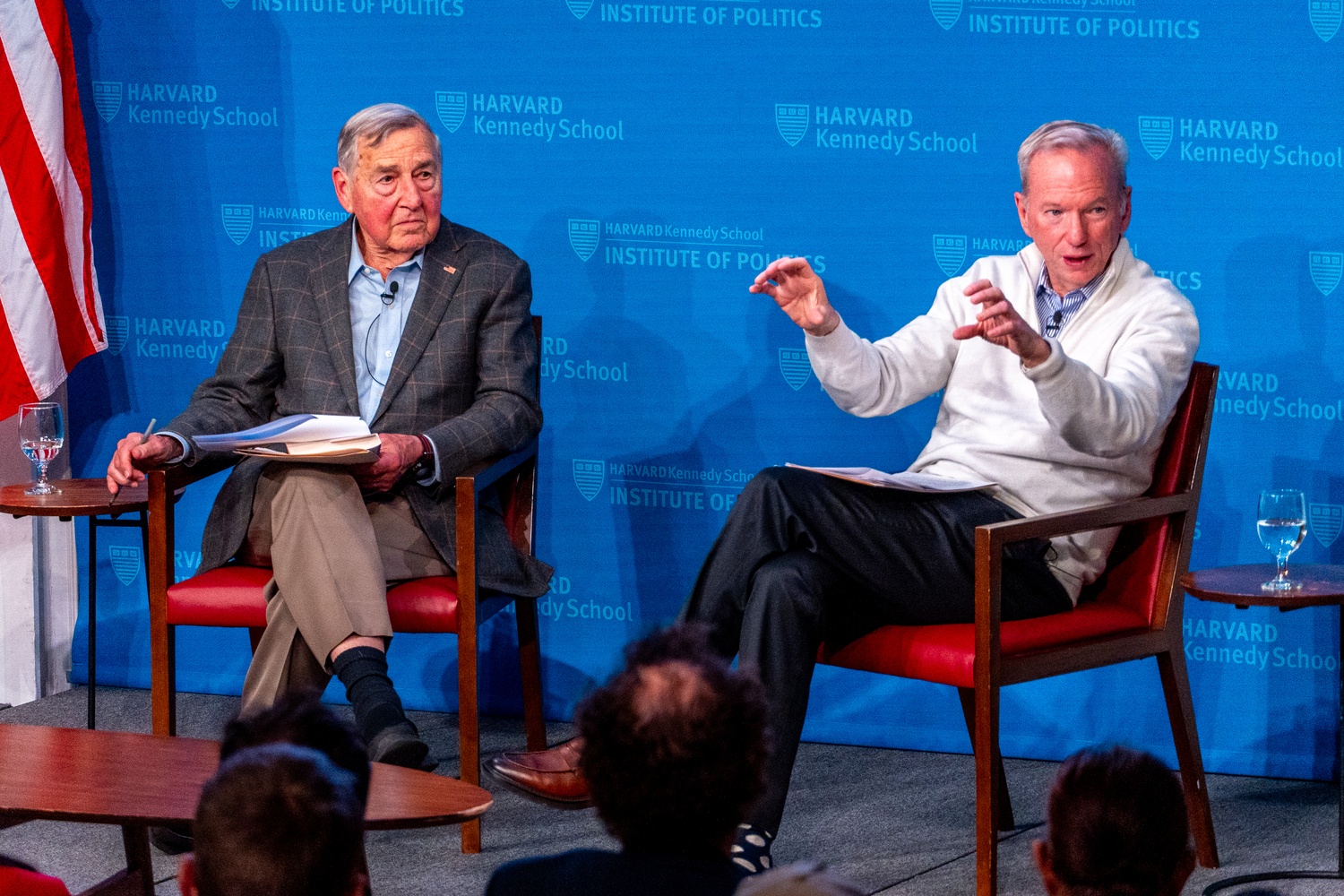
Former Google CEO Eric E. Schmidt predicted that artificial intelligence will be able to learn from itself within four years at a forum hosted by the Harvard Kennedy School on Monday, where he issued a stark warning about the need for limits on autonomous learning.
Schmidt, who led Google from 2001 until 2011, argued in April that the technology will fundamentally change every aspect of human life within a matter of years, labeling his theory the “San Francisco Consensus.” On Monday, he set the timeline at four years.
“Recursive self improvement is when it’s learning on its own. This is not true today. Today, when you set up one of these huge data centers, you know what they look like, you have to tell it to learn. But the belief is that this is coming,” Schmidt said.
“The ability for computers to provide programs to generate medical conjectures and to discover new facts looks like it’s very close,” he added. “Many people believe that there will be AI mathematicians in the next year.”
Despite his optimism, Schmidt warned that as AI develops closer to autonomous learning, there will have to be new conversations about placing limits on the technology.
“Somebody’s going to have to raise their hand and say, ‘We just went too far. There’s too much danger here,’” he said. “We don’t want to give that agency to the computer. We want humans to be in charge of it. It is not agreed to where that point is.”
“I think there’s no higher duty than to preserve human agency and human freedom,” Schmidt said. “That’s going to be a central challenge for all of you.”
Schmidt has been extensively involved in AI endeavors since leaving Google. He currently serves on the board of Sandbox AQ, the Broad Institute, and the Mayo Clinic.
Both Schmidt and the forum’s moderator, HKS professor and former dean Graham T. Allison ’62, published work on AI with former Secretary of State Henry A. Kissinger ’50.
“We are today grappling with the question that he foresaw 20 years ago when we started working on this,” Schmidt said. “What does it mean to be human in the age of AI?”
At the Monday forum, he also voiced concern about the rate of U.S. open-source development in comparison to China, the country’s main rival in the AI sector. He warned that Chinese companies that have embraced open-source AI will be more quickly adapted internationally over closed-source AI models from the U.S., where code is not publicly accessible.
According to an MIT study published earlier this year, Chinese companies and independent open-source developers make up an increasing share of the global open-source AI market, while the market share of U.S. models has declined over time.
Schmidt said that the U.S. government and nonprofit organizations should increase funding for open source AI development with “American values and human values” to compete against Chinese models.
“I don’t see the open-source leadership in America, and I see nothing but open-source leadership in China,” he said. “I think those are the facts.”
He added that China has been better at implementing AI in the production of everyday products, but has focused less on advancing AI to the point of “super intelligence.”
“It appears that the two are pursuing different paths,” Schmidt said.
But he said on the more immediate horizon, AI is naturally on the path toward thinking on its own.
“The scaling law basically says that if you put more data and more electricity and more chips, you get this emergent behavior, one after the other,” Schmidt said.
This eventually leads to reasoning, he argued, granting AI “language, agency, and reasoning.”
“So it’s happening,” Schmidt said. “It’s happening very quickly.”
Want to keep up with breaking news? Subscribe to our email newsletter.