

News
Summers Visited Epstein’s Island During 2005 Honeymoon

News
Summers Will Not Finish Semester of Teaching as Harvard Investigates Epstein Ties
News
Harvard College Students Report Favoring Divestment From Israel in HUA Survey

News
‘He Should Resign’: Harvard Undergrads Take Hard Line Against Summers Over Epstein Scandal

News
Harvard To Launch New Investigation Into Epstein’s Ties to Summers, Other University Affiliates
Stadiums of The Game: Historic Backdrops to the Harvard-Yale Rivalry
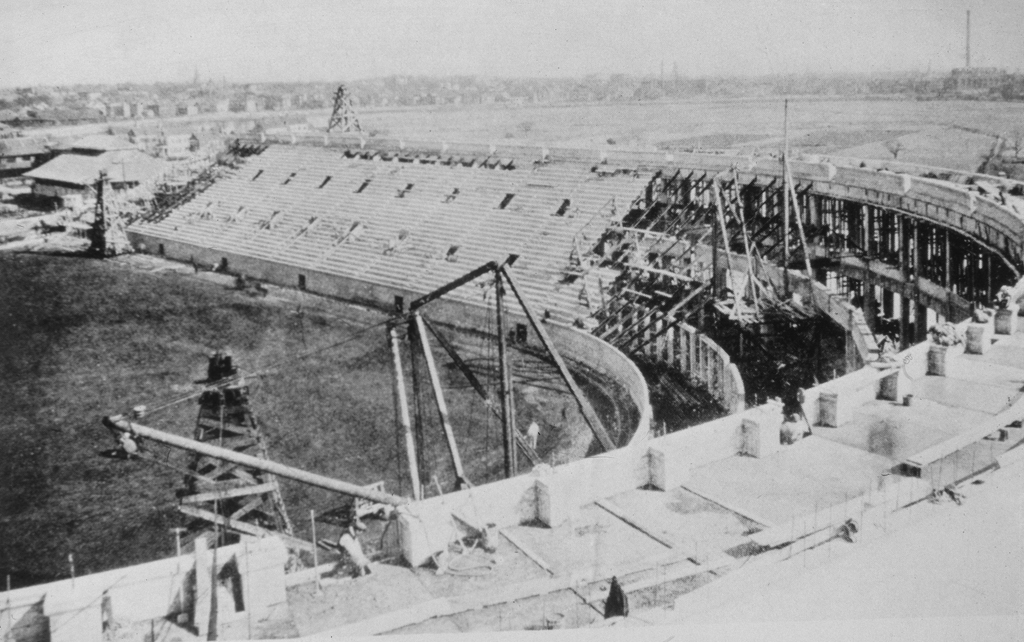
As tens of thousands of traveling Crimson and faithful Bulldog supporters scramble to pack the concrete stands of Yale Bowl or Harvard Stadium every year, the showdown on the field inevitably draws attention away from the historic venues that stage one of football’s greatest rivalries.
For many in attendance witnessing Harvard football’s marquee matchup against archrival Yale, the stadiums’ colorful histories seemingly fade into the background. But over the years, the various stadiums that host The Game have extended beyond mere backdrops, instead helping shape modern football while inspiring the design of other iconic venues.
Harvard Stadium: Concrete Marvel and the Forward Pass
Positioned along the Charles River, Harvard Stadium is the oldest college football stadium in the United States. Architecturally inspired by Greek and Roman arenas, the Colosseum-like structure was completed following only four months of construction in 1903.
Funded by a gift from Harvard College’s Class of 1879, it proved to be an engineering feat, as innovative techniques bolstered by then-Harvard professor Lewis Jerome Johnson helped it become the largest reinforced concrete structure of its time.
Harvard Stadium was instrumental in sculpting the rules of modern football. In the early 20th century, as public perception of the sport increasingly shifted toward concerns of its physical danger, U.S. President Theodore Roosevelt, Class of 1880 and a die-hard football fan, initiated the Intercollegiate Football Conference in an attempt to reform and regulate the sport's rules.
Among many of the proposed rules was extending the width of the playing surface, but despite overwhelming support, it failed as Harvard Stadium’s concrete structure simply did not allow any room for expansion. In lieu of a larger field, the schools opted to standardize field dimensions to match Harvard’s and adopt the forward pass: guidelines that are still in place in modern football. Its unique place in history has earned Harvard Stadium a designation as a National Historic Landmark, only one of four stadiums across the country to receive the coveted recognition.
Since its opening, the stadium has undergone countless restoration and renovation projects. Capacity was reduced by more than 50 percent to 25,000 spectators with the removal of temporary stands, and artificial turf and floodlights were installed in 2006. At the Harvard-Brown matchup in September 2025, the playing surface was officially renamed as Tim Murphy Field to commemorate and honor the long-time head coach of the Crimson, who retired in January 2024.
Aside from serving as the home of Harvard’s football program, the 122-year-old stadium has been utilized for an assortment of intriguing events, ranging from undergraduate intramurals to matches in the Olympic Games. It has held the United States Olympic Track and Field Trials (on the now-removed track), the New England Patriots’ inaugural NFL season, games for the Boston Cannons, and even a concert by the late reggae legend Bob Marley. During the 1984 Los Angeles Summer Olympics, Harvard Stadium also set the stage for six group stage soccer matches.
For the 131st playing of The Game in 2014, the stadium hosted ESPN’s College GameDay pregame show, as Harvard defeated Yale 31-24.
Yale Bowl: Inspirations and Innovations
The 141st playing of The Game is set to be held at the Yale Bowl in New Haven, Conn. Tucked away approximately two miles as the crow flies from Yale’s campus, the second-largest FCS stadium can be found along the border of nearby West Haven.
In the summer of 1913, Yale Bowl broke ground. Its architects opted to construct a stadium in an elliptical bowl shape that also draws parallels to prevalent campus architecture. Upon completion, it became the largest college stadium of its time.
The debut match, however, featured a blowout loss to Harvard. By design, the stadium does not feature locker rooms and bathrooms. Instead, players and coaching staff walk 200 yards to nearby Smilow Field Center to prepare for their game — an infamous trek known as the Bulldog Walk.
The stadium underwent extensive renovations in 2006 due to deteriorating external conditions. The stadium continues to lack permanent lighting. This absence restricts games at Yale Bowl to the daytime, unless temporary lighting solutions for games under the lights are installed.
Its odd yet distinctive “bowl” shape quickly influenced future designs, due to the ability to provide a clear view from all seats. It provided inspiration to other iconic college football stadiums nationwide, such as UCLA’s Rose Bowl in Pasadena, USC’s Los Angeles Memorial Coliseum in Los Angeles, and Michigan Stadium in Ann Arbor. Along with its Crimson counterpart, the stadium was introduced as a National Historic Landmark in 1987.
Throughout the late 20th century, Yale Bowl hosted several professional sporting events. The National Football League’s New York Giants called the Yale Bowl home in the 1973 and 1974 seasons during renovations at Yankee Stadium, although the team could only find victory in one out of a dozen home games played during their brief stint in New Haven and recorded the smallest attendance in the organization’s history. The Connecticut Bicentennials of the North American Soccer League also played at the venue after relocating from Hartford, bringing in soccer’s greatest stars such as Pelé and George Best to New Haven, yet also failing to attract a large fanbase.
As the 1994 World Cup drew close, the stadium aspired to serve as a host venue, but barely missed out after the host committee selected Foxboro Stadium instead for its sole New England site.
Fenway and Beyond: Controversial Matchups at Neutral Sites
Only six installments of Harvard-Yale games have been played away from Cambridge or New Haven. In the 8th playing in 1883, disagreements in illegal substitutions caused the game to be played at the Polo Grounds in New York City. In 1891 through 1894, the meetings were hosted at a neutral stadium in Springfield, Mass., where the highly physical match contributed to at least one casualty, broken bones, and the suspension of The Game for three years.
In 2018, due to ongoing restoration work at Harvard Stadium, the game was shifted to Boston’s Fenway Park, where the Crimson defeated the Bulldogs 45-27.
For the 142nd playing of The Game in 2026, the familiar concrete pillars will once again give way to Fenway’s green grandstands and Boston skyscrapers as the long-time ballpark of the Boston Red Sox host Harvard’s biennial home match for the second time.
Want to keep up with breaking news? Subscribe to our email newsletter.