

News
Summers Will Not Finish Semester of Teaching as Harvard Investigates Epstein Ties
News
Harvard College Students Report Favoring Divestment from Israel in HUA Survey

News
‘He Should Resign’: Harvard Undergrads Take Hard Line Against Summers Over Epstein Scandal
News
Harvard To Launch New Investigation Into Epstein’s Ties to Summers, Other University Affiliates
News
Harvard Students To Vote on Divestment From Israel in Inaugural HUA Election Survey
Study Suggests WiFi May Harm Tree Life
A recent Dutch study found that the radiation emitted by wireless routers and access points has a detrimental effect on trees in the vicinity, but Harvard officials said that the University has not noticed any effects on campus flora.
A study conducted at Wageningen University in Netherlands found that 70 percent of trees in urban areas exhibited odd markings and signs of cell death on their leaves, compared to just 10 percent five years ago. The researchers believed that these findings signaled a correlation between wifi radiation and cell death in trees.
According to Dutchnews.nl, the Wageningen University researchers placed 20 ash trees in contact with emissions from six wifi access points over a three-month period and found that the leaves nearest the source fell off.
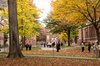
The study may initially seem relevant to Harvard: many areas at Harvard such as the Yard and Quad nestle large swaths of plants and trees, and wireless internet is an integral part of the University’s infrastructure.
But the findings of the Dutch study are not necessarily conclusive, according to Harvard Physics Professor Richard Wilson.
“It seems that the study merely found an increase in problems and jumped to a conclusion that it [tree leaf death] is related to wifi,” Wilson wrote in an e-mail to The Crimson. “This is enough for asking a question but not enough to raise an alarm.”
Harvard’s Facilities Maintenance Operations office echoed that skepticism: “We haven’t notice any negative impact caused by the wifi routers,” Associate Director of Landscape and Business Support Wayne P. Carbone wrote in an e-mail.
The current report does not give enough detail to merit a change in University policy, according to FAS IT spokesperson Noah Selsby.
“According to the article provided by The Crimson to FAS IT, the institution at which this research was conducted is expressing their doubts about the findings by distancing themselves from the report,” Selsby wrote in an e-mail.
Selsby also said that the report lacked concrete detail.
Want to keep up with breaking news? Subscribe to our email newsletter.